 Based on 300+ Reviews!
That Moment in the Driveway When You Have No Idea What to Say
It’s the middle of July. The house is 84 degrees inside. A technician walks out to his truck, comes back with a clipboard, and says your system is “getting up there.”
Then he waits. And you’re standing there doing math you have no way to do.
Here’s the thing nobody says out loud. Most homeowners with a 12- to 20-year-old central system aren’t cheap. They’re stuck. You’d happily spend the money if you knew it was the right money, but you can’t see inside that outdoor unit, and the person who can see inside it is also the person selling you a new one.
That’s an uncomfortable spot. Let’s get you out of it.
By the end of this, you’ll know the three numbers that actually decide repair versus replace, how to read your own symptoms before anyone shows up, and what changed in 2026 that makes this decision different than it was two summers ago.
Why “It’s Old” Isn’t an Answer
Your air conditioning system is old. Fine. That’s true of every system that ever needed a repair.
Age is a fact, not a diagnosis. A well-maintained 15-year-old unit with a clean coil and a tight duct system can outlive a neglected 9-year-old one. Meanwhile, plenty of Mississippi systems get replaced at year 11 for a $340 problem.
So the useful question isn’t “how old is it.” It’s this: what specifically failed, why did it fail, and what does that tell us about the parts we haven’t looked at yet?
An honest answer points at something. A weak one waves at your system’s birthday. Once you hear that difference, you can’t unhear it.
The Three Numbers That Actually Decide It
Forget the rules of thumb floating around online. In a humid Gulf-adjacent market, three numbers do almost all the work.
Number One: The Repair Against What’s Left
Take the repair quote. Divide it by the years the system realistically has left. That’s your cost per year of comfort bought.
A $600 capacitor and fan motor job on a system with six good years left costs you $100 a year. That’s a bargain, and you should say yes without agonizing. A $2,400 compressor on a system with three years left runs $800 a year, and a new system financed over ten will likely beat it.
But notice what that math needs. It needs somebody to tell you how many years are left — an actual remaining-life estimate, based on coil condition, compressor amp draw, and refrigerant history. Not a guess. If nobody gives you that number, you don’t have a decision. You have a sales pitch.
Number Two: How Much Refrigerant You’re Buying
This one changed fast, and a lot of homeowners haven’t caught up.
If your system was installed between roughly 2010 and 2024, it almost certainly runs on R-410A. Production of that refrigerant ended in January 2025, and what’s left is on a scheduled phase-down. Prices have followed. R-410A now runs somewhere around $40 to $75 a pound, so recharging a 3-ton system can land between $480 and $800 with labor.
Here’s why that matters more than the sticker. Refrigerant isn’t fuel. Your system doesn’t use it up. If you’re paying to add refrigerant, you have a leak, and if you’re paying twice, you’re renting the system instead of owning it.
Two recharges in two summers on an aging unit is one of the clearest replacement signals there is. Ask directly: was the leak found and repaired, or was the system just topped off?
Number Three: Whether the Box Is Even the Problem
This is the one that saves people the most money, and almost nobody asks it.
You feel the symptom in your rooms. Weak air. A back bedroom that never gets there. A house that reads 72 on the thermostat and still feels clammy and sticky. All of those feel like a dying air conditioner.
Often they’re not. They’re distribution. Leaking duct in a hot attic, a crushed flex run, a return that’s too small for the equipment, static pressure choking the airflow. Swap in a brand-new unit and the problem walks right into the new equipment with you.
That’s a genuinely awful outcome — five figures spent, and the back room is still hot. It happens every summer around here. It happens because the diagnosis stopped at the box.
Read Your Symptoms Before Anyone Rings the Bell
You can do a surprising amount of this yourself, in about ten minutes, before you’re standing in a driveway feeling rushed.
| What You’re Noticing | Usually a Repair | Usually a Replacement | Ask the Technician |
|---|---|---|---|
| Air is warm, system runs nonstop | One findable leak, dirty outdoor coil, failing capacitor | Second refrigerant leak in two years on a 12-year-plus system | “Did you find the leak, or just add refrigerant?” |
| Grinding or loud hum at startup | Capacitor, contactor, or fan motor | Compressor failure past year 12 | “Is it the compressor, or a part in front of it?” |
| Power bill climbs every summer | Dirty coil, low charge, clogged filter | Pre-2006 equipment running at roughly half of today’s efficiency | “What temperature split did you measure?” |
| Back rooms never cool off | Duct leak, closed damper, crushed run, undersized return | Neither — a new unit will not fix this | “Did you measure static pressure?” |
| House feels damp at 72 degrees | Oversized system short-cycling; may be a control or airflow fix | System too large for the house, replaced correctly sized | “What’s the indoor humidity reading right now?” |
| Third repair in two summers | Rarely | Yes, and plan it before July | “What’s your remaining-life estimate?” |
See the pattern? Almost every replacement row needs more than one piece of evidence. One failed part isn’t a failed system. When a quote leans on a single symptom to justify replacing everything, that’s your signal to ask another question, not to sign.
What Changed in 2026 (And Why Your Neighbor’s Advice Is Stale)
Two things shifted, and both of them affect the number you’re looking at.
First, the federal 25C tax credit expired December 31, 2025. That credit was worth up to $2,000 on a qualifying heat pump and $1,200 on a furnace or central air conditioning system. If your neighbor replaced in 2024 and told you what they paid, their number included help you can’t get anymore.
Second, new equipment is being built for R-454B and R-32 instead of R-410A. Different refrigerant, redesigned equipment, and prices that have generally moved up. Any 2026 replacement quote reflects that.
Both changes push the smart move in the same direction: stop shopping for the cheapest box and start paying for a correct diagnosis. When there’s no subsidy softening the price, right-sizing and fixing your distribution is where the real savings live.
What an Actual Diagnosis Looks Like
Here’s a fair standard, and it’s borrowed from a place you might not expect.
A facility manager would never accept “we’ll swap the rooftop unit and see how it goes.” Before anyone touches equipment on a commercial building, there’s a load calculation, an assessment of how air is distributed, a humidity picture, a remaining-life estimate, and a number in writing. That’s normal. That’s the floor.
Your house is a building, too. It deserves the same treatment.
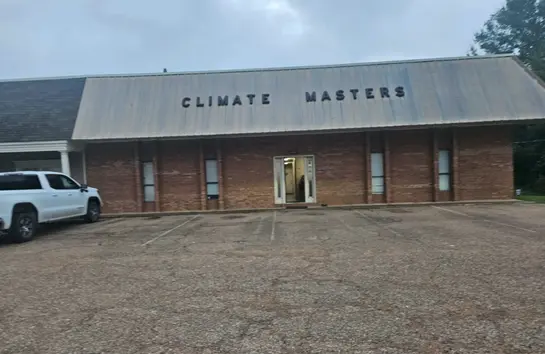
Climate Masters has held commercial contractor licenses in Mississippi and Alabama since 1975, and the same crew that keeps rooftop units, boilers, and retrofits running for churches, daycares, and offices across the metro is the crew that pulls into your driveway. That’s the whole reason the method travels. You can see the commercial HVAC work that shaped it, or meet the team who does it.
What that looks like at your house: measured temperature split, static pressure read at the air handler, indoor humidity checked against outdoor conditions, refrigerant history reviewed rather than assumed, and a written recommendation that names the failed component and the reason.
Then you get both paths. What a repair costs and how long it should hold. What a correctly sized system replacement costs and what it fixes that the repair won’t. Side by side, in writing, so you can read them at the kitchen table without a technician standing there.
Climate Masters works across Brandon, Madison, Flowood, and the rest of a nine-city service area — and after 50 years and 300-plus customer reviews, the crew has been inside your neighborhood’s whole housing era.
Frequently Asked Questions
Is the $5,000 rule still a good way to decide?
It’s a starting point, not an answer. Multiplying the repair cost by the system’s age and replacing if it clears $5,000 ignores the two things that matter most in a humid climate: whether refrigerant is leaking and whether your ducts are the actual problem. A $500 repair on a 12-year-old unit scores $6,000 and says replace, but if that repair is a capacitor on an otherwise healthy system, replacing is a waste of money. Use the cost-per-remaining-year math instead.
How long should central air conditioning last in Mississippi?
Plan on 12 to 15 years, which is a few years short of national averages, because our cooling season is long and humid and equipment simply runs more hours here. Systems on a regular maintenance agreement with clean coils tend to reach the top of that range. Neglected ones with a slow refrigerant leak often don’t reach year 10.
Should I replace before the system dies completely?
If you’re deciding on your own schedule, yes — that’s the better position. A planned replacement in spring or fall means you compare quotes calmly, check financing options, and pick equipment on merit. A July failure means choosing in one afternoon, sweating, from whoever can come today. The exception is a healthy system with one failed part; there’s no reason to replace that early.
My rooms cool unevenly. Will a bigger unit fix it?
Almost never, and a bigger unit usually makes it worse. Uneven cooling is a distribution problem — leaking duct, crushed runs, an undersized return — and oversized equipment short-cycles, which means it shuts off before it pulls the humidity out. That’s how you end up with a cold, clammy house and a bigger power bill. Get static pressure measured before anyone quotes you tonnage.
You’re Allowed to Ask for the Number
Take this with you. You don’t have to understand refrigerant circuits to make a good decision about your air conditioning. You only have to notice whether the person in your driveway is pointing at something specific or waving at your system’s age.
Ask what failed and why. Ask for the remaining-life estimate. Ask whether the leak was found or the system was topped off. Ask if static pressure was measured. Ask for the repair option and the replacement option in writing, together.
Five questions. Ten minutes. The fog clears.
And if you’d rather start with a crew that expects those questions, Climate Masters has been keeping homes and buildings comfortable across central Mississippi since 1975. Check the current specials, read through the common questions, or request service and get an answer you can actually check.
Go pull out your last repair invoice. Read it again with these questions in hand — the answer may have been sitting in there the whole time.